Thursday, September 17, 2009

Shelter Bay Marina in Colon, Panama September 11- 16, 2009

Shelter Bay Marina in Colon, Panama September 11, 2009

The day we decided to leave the Rio Chagres and move on to the marina at Shelter Bay inside the breakwater of Colon, dawned clear and pleasant. Still we lingered to enjoy the quiet beauty around us-

Well, pretty quiet considering the howler monkeys in the trees, and parrots screeching overhead. Up came our anchor about 9:00AM to hopefully sail the 7 miles into Colon.
Jamie on Windsong began his trip in hopes of good sailing, too. As mentioned in previous blog entries, he had no working engine propulsion on Windsong, having had his shaft sheared and propeller lost back in Bocas Del Toro. Both of our boats had made reservations at the marina. Jamie was having Windsong taken out of the water to return to his teaching position in Canada for ten months and Dan and I wanted to see him off, maybe help with his repairs if there was time, wait for more packages of electronics to fix our boat and check out Panama City for a few days.

In a little over two hours Dan and I were entering the breakwater. We had been able to sail about half the distance, then we had to use the engine. We worried a bit as Jamie tacked his way out of the narrow channel from the Rio Chagres but all went well and we worried again as rain pelted down as we were entering the marina and could raise no one on the radio to give us our slip assignment. We could see Windsong, still valiantly tacking along the outside of the gigantic rock breakwater and doing her best to get where she needed to go and avoid the seven or eight anchored ships of various kinds and foreign flags; tankers, container ships, car carriers, cruise ships and yachts waiting in a line to transit the Panama Canal.

Yachts heading for Shelter Bay traverse near this anchoring area called “the flats”. Eleven years previous our trawler Sea Star had spent a month in the deep and muddy flats anchorage waiting for a slip at the Panama Canal Yacht Club. Now the Panama Canal Yacht Club has been closed and there is nowhere to park a dinghy, so the flats anchorage is not used much by cruisers.

After a few unanswered radio calls on channel 74 we made our presence in the entrance to the marina known and were guided to our slip and told that we were lucky, because we got the last slip. I immediately reminded the dock person that two boats had made reservations and Windsong may need help as she had no engine. A few minutes later we heard Jamie trying to raise the marina on 74 to no avail. Knowing that he might have to use his dinghy to assist his entry, we wondered where the marina was going to put him, but he still received no answer on the radio, but at least the rain was lessoning by now.

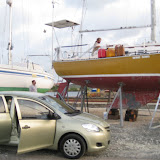
At the entrance to Shelter Bay there is a long dock on the right. Perfect, we thought, for bringing Windsong in safely. Finally by cell phone Jamie reached the marina and was told where to go. Dave, a marina manager and a dock person waited to receive Windsong’s lines as Jamie putted his way in, circled, and driven by port side dinghy tie, eased his starboard up to the dock. We all guided her by lines to the far end of the long dock. It seems the marina staff were actually waiting for a 100 foot yacht expected soon at that very dock!

After welcomes and introductions on the dock Jamie asked about the hauling of his boat. He learned that the lift was going to be shut down at the end of the next day, but extracted a promise that he could be one of the three boats hauled before the lift closed. Feew! That was a lucky break as Jamie had just run out of time and had only a few more days to get ready to leave his boat on the hard and return home to teach Science in Windsor, Ontario for ten months. Of course he was reluctant both to leave his boat and the cruisers’ life.

Shelter Bay is not a cheap place to leave your boat but it is safe and has excellent floating concrete docks with finger piers, electricity, (by meter), potable water, showers and laundry. The amenities were more than we had seen for a long time and we were wanting to use the air conditioning on Sea Star as it had been so very hot! Shelter Bay also has a small restaurant , walking trails right to the Chagres River and the Gatun locks, a free bus to take cruisers to the town of Colon where groceries and hardware stores were said to be available. Since the closing of the Panama Canal Yacht Club they are the “only game in town” and all Yachts transiting the canal find their way to Shelter Bay.

The next issue for Jamie once he arrived safely at Shelter Bay, was a ticket home. He planned to leave the next Tuesday if he could accomplish his next task which was to find a mechanic to machine his new shaft. Meanwhile he had to start to ready his boat for the pull out; bilge pumps had to be cleaned and working well, the boat needed a certain amount of cleaning, sails had to be removed, dried and stored -- the faithful dinghy as well-- and he thought he was going to have his mast taken down and removed from the boat.

The real fun began at the nest issue. Jamie has a cat, Spot. She was a rescue cat and had been a faithful, uncomplaining sailing buddy, and she was expecting to go back to Windsor, Ontario with him, maybe climb a mountain or two and get her feet back on dry, stable land.
Panama regulations and airline red tape made this a difficult task and almost caused him to return home later than he should have for work. Because Panama is hot and Miami or Texas, cities he might fly through, also hot, the airlines had regulations about an animal in cargo flying when the temperature was too high. He found he could not carry the cat aboard the plane on which he had already bought his ticket. He couldn’t ship the cat in cargo as an individual, he had to hire an Animal Exporter to certify the animal was healthy and capable to fly and arrange the flight with an airline. The animal needs to have all its shots and see a veterinarian within seven days of the flight, then the Exporter had to certify the veterinary signature- and all this, he was told, could not be accomplished in less than three days!

He extracted a promise to try to expedite the process and decided to bring the paperwork to Panama City that afternoon. He had updated the cat’s rabies shots in Bocas and had a clean bill of health for the cat so cat in carrier and Jamie and Dan went off in the Shelter Marine bus, then a taxi in search of the local vet in Colon to sign off on the seven day requirement.
The only vet office cruisers knew of was closed, permanently! Next the guys rented a car and somehow found a feed store where, speaking pigeon Spanglish they communicated that they needed a vet. The store keeper found another vet who agreed to come to the store in his car. He provided a rabies tag as if Spot had just been vaccinated and then Dan, in a rental car, took Spot home to the boat (let’s just say Spot doesn’t ride well in a car) , and Jamie jumped on the express bus for Panama City. There he was able to meet the Exporter who took pity on him and provided the paperwork needed, and the name of a pet friendly hostel in Panama City which would allow both the cat and Jamie to make their flights-and all for only $750 fee and ticket for the cat alone!

Yikes, there was still a lot to do. I helped by folding sails and cleaning the dinghy, but Jamie worked non-stop until 6:00PM when we all left for Panama City in the rental car. We should have been there in 45 minutes but as luck would have it we missed the turn off in Colon for the toll road and found ourselves bumping along a construction zone and terrible uneven pavement with detour after detour on the “libre” all the way into the city.

Finding the hostel Balboa Bay, Panama was a bit tricky. Spot was welcomed by the friendly owners and the three of us were off to find our hotel and dinner. This part all went well. Dan and I stayed at the Marbella Hotel that had nice clean rooms and a good spot for a rental car, we ate Pizza and lasagna at Monolo’s Italian Restaurant, then Jamie took a cab back to the hostel and the next day Spot was transported by the Pet Exporter and made her flight. Jamie was transported by us and made his flight.

A few pics: but don't forget to come back for the rest of the blog!

table style="width:194px;">Wind Song's abrupt lading
Dan and I drove through Panama City, mostly in a deluge looking for a boat store by the name of Abernathy’s that we could not find. We started to head back to the hotel when purely by chance we stumbled on it in a maze of one-way streets and bought a few things we needed. We walked to a movie theatre from our hotel, seeing our first movie out since Massachusetts, I think. It was Pelham 1-2-3 with John Travolta and Denzel Washington and a good action movie.

The next day on the way back to Colon we did some birdwatching on a road near Gamboa called the “Old Pipeline Rd”, famous in the Ridgley guide for lots of birds. In the woods we met a young Panamanian bird guide, Jacobo Ortega, who said he could identify 500 birds by their call. We were only with him for an hour but he pointed out many birds we would not have seen, White-tailed Trogan, a Black capped Pigmy Tyrant, and Masked Tityra. We want to hire him for a trip near the marina where there are more trails and roads suggested in the guide.

So now that Jamie has gone to land, Tregoning is still in Bocas and Sea Star is tied up at dock, our pace has slowed. I’ve tried cruiser volleyball for the last few days, Dan has done some more boat repair work, searching the US on the internet for a discontinued Pro Sign 2 control for the inverter. We have ridden the Shelter Bay bus to town and lugged back groceries-stores almost like the states! Plans are not made yet for next stops. Our cruising permit for the boat in Panama will need renewal in a few days. We think we would like to visit the San Blas Islands of the Kuna Yala after a few coastal stops-but we, like most cruisers, are looking forward to a trip back to the states to visit family and friends, for Dan to take a class and maintain his plumbing and electrical licenses, both of us to see various doctors and dentists, and of course, procure more boat parts. That might happen in late October so we need a safe place to keep the boat. Our dilemma is that Shelter Bay and Cartagena are really the only two marinas in the direction we are planning to go.


shelter bay OL
<

Sunday, August 30, 2009

Escudo De Veregas, Rio Euero, Rio Chagres August 17-27 2009

Escudo De Veregas, Rio Euero, Rio Chagres August 17-27 2009

The packages containing electronic equipment to fix the boat after the lightning strike arrived by plane and boat, we installed the new equipment, replaced the seven AGM batteries with the seven new ones, checked everything again, and Sea Star was ready to sail within a month of her hit. At the time we thought our little group of Windsong, Sea Star and Tregoning were going to move on together yet again. We said our goodbyes to newly made friends in Bocas, thought about the things we didn’t get to do, yet it was time to leave Bocas Del Toro behind.

Windsong, still without propulsion other than sail, left a day before us heading to Escudo De Veregas, an Island that was reputed to be the “Jurassic Park” of Panama. The bird life was said to be exceptional. Sea Star and possibly Tregoning were going to meet Windsong and explore the island together. Jamie made the anchorage just at dark and spent a rather rolly night on the hook, leaving the next morning. At our regular SSB radio communication time of 9:00AM he was considering leaving Escudo unexplored unless a suggestion for a different anchorage could be found. No luck. In the west wind there were no good anchorages. Windsong, after managing with difficulty to raise his anchor in the west wind and not be blown onto the shore, left the island.

Well, Sea Star was not to be denied this island paradise, while Alison and Randall on Tregoning were delayed waiting for their mail to arrive, we made our way the 45nm to the very same anchorage that Jamie had left, and in the same wind. In the afternoon at anchor Sea Star was very comfortable and the weather was cooperating. Dan and I were sitting in the cockpit at sunset when the caretaker of the island Tortugas (sea turtles) and his son arrived in their motorized cayuco. This very interesting and friendly man explained to us in a mixture of English and Spanish how he and his son count and record the Green Turtle numbers and births and keep the natives from killing the adults for food. He welcomed us to Escudo, saying we could go ashore, walk the beach and see the turtles, fish if we wanted, because it was not a restricted park. A contribution was expected and we were happy to give the man $10.00 and two beers he hinted at as our way of contributing to turtle conservation efforts.

We had planned to go in to shore to birdwatch, explore and take our dinghy into the many mangrove lined coves but… as had happened with Jamie the wind picked up bouncing the boat around and pushing us ever closer to the land. At dark, the wind was gusting to 20kn and by 10:00PM torrential rain was falling and we were bouncing bow to stern and rolling, too.

Around midnight we heard a huge “clunk”, and each time the bow rose and fell it sounded again. We had anchored with our all chain rode and had 150’ out protected by a 30’ nylon rope for a snubber. The snubber had let go, so we in our raincoats and nothing else in the pitch black had to go out on the deck and replace the knot that had loosened while the boat pitched, thumped and creaked. We did not sleep very much and in the morning when the time to communicate by SSB came, we were still hoping that the forecast of very light winds and mild seas would occur. We took the big boat (to put the dinghy down would have been dangerous in the swell) around the south side of the island looking for a calmer spot to anchor. Since we could not find one, and the coral reefs were hard to see under the dark water with no sun on it, we were chased out of Veregas, just as Windsong had been! I'll bet it is a fascinating place and when the weather is right, a real gem.

So what to do? The Captain, Dan, wasn’t ready to just go on yet without some adventure. He checked out our guidebooks and compared notes between them and we decided to try another day stop at one of the jungle rivers along the mainland coast of Panama before going to the Chagres River. The guidebooks showed many to choose from; one where natives sell shark parts to Japan, one with a native village, some fishing villages where you had to surf over waves to enter the mouth of the river. We had about 45 nm to go after we motored along the south coast of Escudo De Veregas, so we hoped for good wind and weren’t sure where we would head to-how far along the coast we could get.

As we sailed along at about 5kn, we noticed a great deal of bird life out in the open sea, so I put out our trolling rig in hopes of catching a Mahi Mahi. There was debris in the water; small and larger logs and limbs, floating sea weed and grasses. We saw rafts of hundreds of terns, brown bobbies, Frigate birds and even one bird that could have been an Albatross working the waters while shimmering fish were splashing and jumping out of the water. The small birds were cute as they floated by us perched on logs. If it was a long log there might be twenty birds all in a line whereas a small stick might have just one. They would fly off only when the boat’s bow came near to hitting their perch.

My first catch was a small shark, a three footer. I don’t know what kind and we cut the line and lost the lure. Maybe an hour later I caught a Cero, which Dan decided wouldn’t be a good eating fish and let it go! Then in quick succession I hooked and Dan gaffed aboard two Black-fin Tuna of at least ten pounds each. It took me a while to clean them using directions from a book, “The Cruisers Guide to Fishing”, and it was a bloody affair on a sailboat. We haven’t eaten any yet as I need a few good recipes and some lime or lemon.

When I came up from the galley after cleaning the fish, Dan knew we would have to really bring our speed up if we were going to reach the Rio Euero anchorage before dark. We turned on the motor, took in the sails as there was little wind and cranked up to 2700RPMs and put the anchor down in a strange river right as the sky grew pitch black. On the way we were traveling at ODS-optimum dolphin speed! (I think it’s about 7kn) We had a pod of the sleek bodied creatures playing, jumping and whooshing under the bow of Sea Star for about an hour as we headed for the coastline and shore. All told it was a very exciting day on the water and sort of made up for our missing Escudo De Veregas.

The next morning was pretty and sunny-the anchorage hadn’t been calm but we did get some sleep and Dan was ready for his jungle adventure. I took one look at the surf outside the mouth of the river and questioned his sanity. We gathered the usual gear; my camera, his camera and lenses, binoculars, water bottle, sunglasses, shoes and socks and started off to the mouth in the dinghy, sighting and photographing a Black Hawk on the way. We saw the waves at the entrance and landed down the beach to go take a look. Dan waded in to his chest to check the depth and current strength, then we took all the gear out of the dinghy on shore, and hand guided the boat in through the chosen path. Of course waves lapped in and filled the dinghy with Dan in it. He bailed as I steadied the dinghy and without further mishap, gathered the equipment and went for our river ride. It was great fun and there were lots of birds. We heard howler monkeys and parrots in the trees. We saw trees full of Toucans, Arricari and other birds and paddled quietly while the rain started again. When it poured we were able to tuck under trees and vines with huge leaves. After about two hours in the river we decided to go back. Leaving the river was easier than the entry. Apparently the current had quieted and the surf was nowhere near as high as previously so we just blasted our way back into the bay with our gear in a dry bag in the bow locker.

We had been the only cruising boat there and at Escudo, too. We discovered we could trust our newly installed instruments even though the chart plotter showed our anchorage as on land -since we also have paper charts and guide books as backup, we knew the error was not the instrument’s malfunction. Now we were ready for our 52nm trip to the Chagres River.

The next morning early we started for the Chagres and arrived there by 2:00PM after a rollicking but comfortable sail at about 7kn as the current was helping us along the coast. It wasn’t easy for Dan to locate the Lajas Reef, a marker to guide the Captain’s choice of path into the Rio Chagres past the San Lorenzo Fort in the rather rough seas. We followed the Bauhauss and Zydler guide directions and did pass in 13 feet of water but no less. We found Windsong anchored well into the mouth of the river and we dropped our hook there, too. Tregoning was still in Bocas Del Toro and we hoped that they would soon receive their mail and join us, but it was not to be.

I remembered visiting the Chagres on our previous trip eleven years ago. I remembered watching a Bat Hawk, dinghying up river tributaries and hearing howlers and noisy birds. I was wondering if it was too much to expect the river to still hold its magic. It was even better than the last trip. The Panamanians have taken the canal area and are managing the resources there as a National Park. We found the river and its banks clean of trash except very close to the road to the canal and pristine with no development allowed, the paths and walks filled with wondrous sights from butterflies, birds and orchids to larger animals such as monkeys (White-faced and Howler)and sloths. We dinghied some of the tributaries, visited Fort San Lorenzo and walked near the dam on Gatun Lake and along the Panama Canal. The birding find of the trip was a pair of Southern Lapwings with young. Dan saw them distressed and hopping about when he was walking near the Gatun Dam area and a caretaker mowed down a meadow in which the birds were nesting. When we left, the baby bird was alright and burrowed into the mowed grass, and the adults were dive bombing us as we walked and every car, truck or bus that passed on the road to keep everything away from the nest. You had to feel sorry for them. They were frantic. We think the is a rare bird to see in this part of Panama.

And then there were the monkeys. We were able to watch a troop of howler monkeys eating fruits in a tree right on the Rio Chagres. There was a set of old concrete steps leading up a lump of dirt that we climbed and improved our view to looking right into the tree.The pictures speak for themselves.

We left the Chagres on Wednesday, August 26 for the 6 nm trip to Colon and are currently residing on the dock at Shelter Bay Marina. Jamie on Windsong is about to leave his boat on the hard for the next ten months while he returns to his teaching post in Windsor, Ontario. Tregoning may still join us here or we may see them in the San Blas. One of the hardest things about cruising is saying goodbye when plans don’t mesh anymore. Blogs are great! Both Windsong and Tregoning have written blogs at the same time as I have. Check them out at tripsailor.com/Tregoning and wincom.net/jhalpin/windsong.htm


Dan shot most of these photos- enjoy the slide show
Escudo-Chagres OL

Tuesday, August 18, 2009

Bocas, Batteries, Boxes and Booms! August 16, 2009

Bocas, Batteries, Boxes and Booms! August 16, 2009

At the end of my last blog entry I wrote that Sea Star was struck by lightning. The strike was on July 18th and was quite extensive, though, luckily, no damage of a permanent nature (that couldn’t be fixed) to Sea Star or her owners! I’m not really sure about Maggie, the ship’s cat. She has become much more skittish when she hears thunder and it’s raining.

We arrived in Bocas on June 18th in hot and humid weather. There were a few days where wind for a short time was 20kn or so in the anchorage but there were almost daily light sprinkles-“Hey, it’s sprinkling, finally some fresh water wash for the boat!” The skies did not open up on a regular basis.

It seems to me that the wet season is early as we have been getting daily rain, especially night and morning, necessitating popping out of bed and attending to hatches. “Son of a b****. I just opened them up and it’s raining aagain!” Hatches HAVE to be opened as the nights are hot and sticky, and the wind has dropped off to very little. When it pours, cruisers, wearing nothing but a smile, run around their decks setting up rain catching “gear” as well as closing and opening the hatches. We call it the “hatch dance” and it accounts for many yawns and a “cruiser midnight” of about 8:30 PM.

When we decided to take Jamie’s suggestion to go to Boquete I luckily asked the right person to care for Maggie. Apparently as soon as we left the skies opened up and Thor sent thunde ,and lightning from his mighty bow right to the mast of poor Sea Star. Sue on Waldon was feeding Maggie while we were away and watching out for our boat. Things can happen; we could be boarded by the locals looking to sell their langostas, we could drag anchor or someone could run too close.

Sue was confused when she noticed that we hadn’t done things we had talked about doing before leaving. Our switch for the anchor light was off. Not a good thing in an anchorage -and we told her we would leave it on! Then she noticed that the refrigeration was off and wondered why we would do that! She tried to call our cell phone many times but we were by then out of range. She grabbed some food as the refrigeration warmed to save for me and continued to care for Maggie- and think about our boat and the fact that the weather on Friday and Saturday was terrible with a huge storm having moved through.

When Dan and I were at the Avis Rent-a-Car return after our fabulous trip to Boquete, we checked the messages and finally called her back. She was on the boat and Dan had her turn things on and off and ..well..it was obvious we had been struck and things were not good on Sea Star- by chance we learned later, the only boat to be struck.

So what did that mean to us? TRIAGE! What was not available that was essential? After calling Jackline Insurance and notifying them Dan got to work. When talking with Jackline they said they had an assessor “really close to us- in St. Vincent and the Grenadines.”
“Uhh.. not too close to us”, Dan countered-“600 or 700 miles, and the boat is not in sailable condition.” So the adjuster said to prepare our best estimate and submit it.

With Jamie on Windsong, and Jeff on Waldon’s help the trouble shooting began. We already knew we had no anchor light and that lights on the electronic panel were off. When the engine started Dan knew the engine was not getting charge to the batteries. LED lights on the boat were unable to be shut off and all sorts of weird readings came off our instrument panels. Our wind generator had shut down, we had no refrigeration or freezer (that was actually helpful as we had no way of keeping them charged up anyway), and one by one other items were discovered defective.

While Dan worked, so did I. I had three pounds of hamburger to cook, a turkey breast, easily ten pounds of beef, some for stew and some steaks. As I’m cooking away and in the middle of a turkey roast-the stove turned its circuit breaker off and stopped!

With an “oh, no, heard here and oh, shit heard there the guys did their best to assess the damages. We had NO autopilot, computer, Raymarine chart plotters-an E80 and E120 read seatalk failure, all depth, wind and speed gauges were out, tachometer and other engine sensors were no good- the VHF radio and SSB were not receiving, the entertainment centers-one TV and a satellite radio were not working- if Dan were writing this he could be more specific but you get the picture. There was to be no moving this boat-

On the positive side we did not see any outside or hull damage and since we had been anchored in 40’ water, a thru-hull failure would have been a disaster. We could have arrived back at Sea Star to see 20’ of mast above the water! So we can say with authority, “It could have been worse.”

Two weeks after the strike we had to get an estimate to Jackline. That was tricky because there was absolutely no way of knowing which components might work again if a part were fixed, or a wire was changed. We put together as conservative an estimate as we could to bring the boat back to her former glory-but in the meantime we had begun the ordering process for what were the essentials. The process was to check what equipment we had, search for serial numbers, and parts available, then list the item number on the sheet to put out for an estimate. This was an all encompassing task for Dan for a week. He ate, slept and perused the computer figuring out what we had, and what was the current replacement. Then I typed it, we submitted it to Jackline and sat on pins and needles—for less than a day- until the bottom line was approved!

How does a person get packages shipped into Panama? What will customs charge for a Yacht in Transit? Where the hell is Bocas Del Toro?? Other cruisers gave us leads and that was the best way to have discovered Arturo at Marine Warehouse, PackYa and other ways (ship and truck) to get items from the US to Panama City and then on to Bocas Del Toro by air- in the middle paying a great deal to Fed-Ex for timely shipments.

On one day we received the six packages from two different shippers by the Panama Air cargo at the Bocas Airport. Four of them were late in arriving because Panama City was having a severe storm, so in the morning we took our two huge packages to the boat followed by four more even heavier in the afternoon. Into a taxi and to the Pirate’s Restaurant dock we lugged them all, into the dinghy and onto the boat to open them, just hoping all would be as expected. About that time Jamie arrived, seeing our loot and because he is young, agile and really nice by that evening we had our anchor light and VHF operative.

Before we could really rest on our laurels, our second shipment came. This time it arrived by ship. BEFORE the strike we had ordered new batteries to replace our only 3 ½ year old AGM battery bank of seven batteries. Each battery is 35 lbs and needed to be taken from the truck that carried them on the supply ship, carried down a rickety dock and lowered three feet into dinghy. Dan and Jamie lugged them aboard Sea Star and installed them in place of the seven old batteries without blowing up the boat while working in such tight a space with such volatile wiring.

So now every cabinet in the boat was open and every tool in use or cast aside temporarily, leaving Maggie and me absolutely no place to be. From the forward cabin the mattress was ajar and folded to access the storage under the bed. The forward head had been acting up and was stripped of its plastic covering and unusable, large and small boxes of Raymarine equipment were piled throughout the salon and the new refrigeration units were sitting on the galley countertops. Electric pumps; bilge pumps, pressurized water had been shut down for safety, either the seven new or the old batteries were in the salon depending on how the project was progressing, the aft cabin was holding all the “usual stuff”, like the pillows and table from the salon, the water making bottles, cat carrier, diesel jugs and plastics from the aft lazzaret, and by now the guys were installing the refrigeration in the starboard lazzaret, working around the pedestal in the cockpit- and it was pouring allowing no hatches to be opened for ventilation.

At the end of Tuesday the 18th, Dan and I were out motoring around and calibrating the new autopilot, speed and depth gauges. The mess throughout the boat remains, but it’s a little less. Jamie, with problems of his own- NO engine and he “lost” his propeller right off his shaft a few weeks ago is waiting for us to get it together so he can move to where his new shaft is waiting- in Colon, sailing, only there is no wind. He kept himself busy climbing another cruiser’s mast today. Tregoning, the other boat we have been in company with, are awaiting the return of their broken inverter and for some mail, then they will head to Colon.

As I write tonight, we are planning a Thursday departure to Colon if possible. All the newly installed gear is being tested. Some works fine and some is acting funny. We’re hoping the windlass works and brings up the anchor, and the new components in the bow thruster can steer us to the diesel dock. We have not totally cleaned the boat of “old stuff” (only three years old), and I’m trying to make room in storage for items we may be able to resurrect “someday.” We can see the full fix is a long road ahead.

Why did Sea Star get the hit? Why not? From what we hear there is no way to prevent a strike. It’s the luck of the draw. I hate to site this couple, but a few days before our strike we met a couple on an Oyster sailboat who have been struck three times! Now that’s unlucky.

Sea Star is a well made Island Packet sailboat, has the proper grounding of equipment and a little brush instrument on the top of the mast that is reported to dissipate lightning. Dan and I are aware of the dangers. Before we left we tucked a few removable items in the oven, a make-shift Faraday Cage, “in case of possible lightning”, but the built-ins can’t be protected.

Cruiser’s laugh when the old saw is repeated, that “Cruising is the fixing of your boat in exotic places” and I used to laugh, too. Let’s hope these repairs to our three year old boat is all the “fun” we have like that for awhile, and Sea Star continues sail on without incident.

Here are a few pic of the repairs. And just to show you we still can have fun in adversity- check out the other fire story from Bocas Marina, Calipso Cantina. Hot, Hot, Hot!

lightning July 18th, 2009

Tuesday, August 4, 2009

Almirante, Chanquinola, David and Boquete July 18, -21

Through Almirante, Chanquinola, David and Boquete July 18, -21

“Let’s go to the mountains” Jamie on Windsong suggested. He researched what he felt would be a fun trip including a zip line through the canopy and a strenuous hike up the Vulcan Baru trail reached from Boquete, a town at the foothills of the mountains well known for the quality of its coffee. Immediately Dan and I thought we should go-we love coffee, but we thought we should slow the pace down for us. We agreed to accompany Jamie from Windsong and Alison and Randall from Tregoning, but at a birdwatcher’s pace that would not include a zipline or Vulcan hike.

BUT First:
All three boats have been in Bocas for a month, so to remain legally in Panama we needed first and foremost to renew our Tourist Visas by July 18 and not too much sooner, and not later as there are fines for lateness. We find the rules confusing. Because we live on a boat, we need something called a Mariner’s Visa even though the boat is covered for 90 days by a zarpe. If a person flies by airplane into the country, they are given a visa good for six months. For some reason a cruiser needs to appear before Immigration officials every 30 days to renew a Mariner Visa, but the Mariner Visa is only good at a few specified places, like Bocas, and we might have to do the Visa thing again as soon as we go to Colon.

Anyway…….the head man at Bocas Immigration suggested we have copies available for the Changuinola office of our passports, our stamps in the passports, all our boat papers and papers given us on our initial entry into the country and have two passport –size photos for each of us ready ahead of time, which we all prepared and did indeed save us untold issues in Changuinola the next day.

We had the water taxi to Almirante, a tiny sea coast town, pick us up with all our luggage at 7:30 AM for the 30 minute fast boat ride to Almirante where we were rushed into a van-taxi and off for the 45min. twisty, bumpy ride with our driver animatedly talking with his girlfriend, driving holding her hand, and taking his hands off the wheel to put them on her many times- to the Capital of Bocas, Changuinola ,and the Immigration office.

We were the first group to arrive at the office in the morning and the young woman who had us fill out forms-laboriously- one person at a time-by hand was very pleasant and seemingly efficient. We had arrived by 9:00AM, done our homework in having the copies ready and things seemed to be moving smoothly, then more people came into the one room crowded office, and more people. The two 12” fans hadn’t a chance of keeping up. All the turquoise plastic chairs, desk chairs and wall space were filled with people and our luggage- and the woman who was head of the office was not there to begin our paper trail, so we all sat, and read and sat some more. We finally headed out for breakfast, walking through the Chanquinola version of a mall-open storefronts with a large selection of clothing and merchandise farther back in a large open room. We were called by cellphone when the head lady appeared-around 11:00 AM and were back to Immigration within 10 minutes of the call.

People came, went in to see the various employees, chatted, presented passports, kissed babies, had coffee and still the five of us sat in the turquoise chairs -1:00 PM, 1:30, 2:00 PM and finally after I nearly blew a gasket we were courteously waited on and given our Mariner Visas and we only paid $35 each, or $70 per boat in addition to the close to $300.00 the officials extracted in Bocas Del Toro the previous month when we arrived.

Now we were in a hurry. Originally we had thought, pick up the visas, and get to Boquete in one day. Luckily by now we had fatalistically decided this couldn’t be done. The bus we were now running through town to meet from Chanquinola to David would take 4 hours and from David to Boquete another 45 minutes. Once on the bus, we relaxed for the 4 hour trip to David and enjoyed the scenery, laughing about our morning in Immigration. Our entertainment on the ride consisted of watching the seats fill and empty with the indigenous people and their children and baggage. Seats were constantly full to overflowing.

The trip is over mountainous terrain and the bus has to sluggishly gear-up the mountain roads. To increase the power available, the driver turns off the air conditioning- but that is not too bad in the cooler mountain air as the passengers can open the windows-if the family sitting next to you wants them open and doesn’t bad-vibe. The bus made a stop at a roadside bus terminal cafeteria after two hours of travel. We were grateful for that as part of the ambiance is that you are hanging on and trying to stay in the seat the whole way. We got back on the bus and enjoyed the rolling hills and open fields full of cattle grazing as we entered the larger city, David. At the bus terminal we loaded up with our backpacks and bags, taxied to where we were to stay the night- in a cruiser recommended hotel named El Castillo. Our rooms for $40 were clean, had working bathrooms with showers, TV, and the hotel restaurant served passable food, so we rested well. We were going to have an early start in the morning.

Dan and I split from the others, deciding to rent a car and take a leisurely drive to Boquete. Alison and Jamie were planning on experiencing the zip line in Boquete at 10:00 AM that morning and they and Randall continued by taking the bus, supposedly 45 minute drive to Boquete- it took them 2 hours. Dan and I drove into Boquete in our fairly new rented from Avis, Toyota Yaris, a very comfortable car. We drove the outskirts of David on the Panamerican Highway, a very well kept road passing many beginnings of condo development and other construction, supposedly being built for the ex-patriot population moving into the area.

We arrived at the clean agriculturally based town of Boquete where fields of tomatoes,onions, strawberries and even sweet corn are grown. We parked because yellow detour signs were closing off the center of town where multicolored balloons and indigenous Guaymi Indians families, the women in long colorful dresses decorated in wide ricrac of various contrasts. There was a children’s fair there that day and these farm families were enjoying a day in the city square with their children.
Here are the traveling pictures to and from Boquete- Don't forget to come back to Blog to see the Finca Lerida set!
Boquete traveling


Finca Lerida-Boquete
Dan had checked online and found what we thought would be a great place to stay-outside of town at Finca Lerida, a coffee finca that advertised good birding. The authors of some of our most respected bird books had stayed at Finca Lerida and recommended it highly.

What a find! We were delighted by the beauty of the property- acres and acres of undisturbed forested area, jungle-like with huge trees and spreading canopy. We grabbed A Guide to the Birds Of Panama by Robert Ridgely and spent the rest of that day exploring on the Finca trails-there was so much birdlife that I might be staring intently into my binocular identifying one bird and he another when we might see or hear another and get distracted.

Blue tinged birds in the coffee plants, yellow along the trail, and hummingbirds in the flowers along the front and rear gardens all teased us with their hiding in the foliage and quick darts out for tiny bugs. We identified Blue-grey Tanagers and Flame-colored Tanagers and many more thrushes, finches and more.
These were the 10 room doors:
From Drop Box


The others joined us at the Finca and were just as delighted as we were-but Alison and Jamie were going to hike the Vulcan Baru in the early morning, a 5:30 AM start, so early to bed was necessary for them. We heard their stories about the zip line, a memorable adreniline experience, ate at the Finca restaurant and called it a good, long day.

The morning they started off was definitely cooler-cold than we had seen since Newfoundland , clear and lovely with the mountains looking purple and shades of blue when the mist lifted. Alison and Jamie were picked up by their guide and were on the trail early. The hike was to be about 7km and then an overnight on the trail, a quick ascent the next morning so sunrise would be on the Vulcan Baru mountaintop and the trek down. Unfortunately, Jamie became ill about half way up and had to stop. Alison, a little ahead with the other guide didn’t realize there was a problem with Jamie. She ascended to the top of the mountain, and also came down- part of the trip in the dark when she realized that Jamie was so ill he couldn’t make the trip. Both of them were disappointed by the changes in plans, and the guide warned Jamie he might need to go to the clinic for a blood test. They arrived back at their room at the Finca about 9:00 PM. What a long, exhausting day!

The same morning Dan and I were walking one of the trails on the Finca property and were thrilled when we were lucky enough to see a male Resplendent Quetzal flying through the canopy, and then landing in a tree among the air plants and bromeliads. We were able to see just glimpses of his brilliant iridescent green and red coloring through the branches when the wind blew some leaves out of the way using the highest power on the binoculars and looking almost straight up. At another vantage point we could see the tail and rump of the huge bird hanging through the foliage-keeping its balance. We searched for it again the next morning with Alison and Randall, while Jamie slept in, but no luck.

As we were leaving Finca Lerida of course we bought coffee. The Lerida coffee is prize-winning, rich and aromatic, and had a chance to speak with the knowledgeable bird guide, Victor, who had compiled a list of close to 200 birds that have been seen on the property. Dan and I were very happy with our selection seen and we had a chance for a few wonderful photos-and some not so great ones, and trail walks that were wonderfully scenic along twisty, slightly overgrown paths through the forest and fields! Lerida does maintain the paths very well, however.

Way down a hill in a path leading in from coffee plants we started to listen to the squauwking of some birds and did observe the Three wattled Bell bird, kind of the signature bird of the place, of course we heard its distinctive squawking call in the high canopy and had a very frustrating time spotting it. We heard the “ping” of the Solitaire but could not spot that bird, either. Outside our beautiful accommodation we spotted four of the perhaps 14 species of hummingbirds, two that are only found in western Panama and the Chiriqui area, many smaller birds, such as the flower piercer shown below, hawks, vultures, swifts and parrots, plenty of butterflies and interesting insects. Our road trip and time in Boquete had been a great.

Here are some pictures-mostly by Dan
Finca and birds


Then it was back to David, drop off the car and take the bus to Almirante and the water taxi to Bocas Del Toro---to find out that Sea Star had been hit by lightning the Friday we had left! More on the troubleshooting and needed repairs—at least we didn’t sink—in next entry.

Tuesday, July 14, 2009

Bocas del Toro July 5-13, 2009—Rio Cricamola

Bocas del Toro July 5-13, 2009—Steve’s visit

Sunday July 4th our son Steve flew in to Panama City on American Airlines, stayed overnight at the Milan Hotel, boarded the Regional flight to Bocas and arrived in Bocas at 8:00AM. We were so excited to see him as we hadn’t seen him in the year since we started our cruising.

We started a whirlwind of activities that didn’t stop until he flew back to Panama on July 12th . (Unfortunately, when Steve arrived in Panama his flight was cancelled or changed and he didn’t get to leave Panama as planned!)

First was a big welcome breakfast at Lily’s Café as the airlines gave him nothing. Then off to Sea Star with the bags with Steve driving a dinghy for the first time in years. We happily climbed on to Sea Star where we chatted, perused our “boat gifts”, boat filters, zincs, and repaired binoculars, and he got reacquainted with his cat Maggie, who now lives on the boat. We went out for a walk around Bocas Town, down the two main streets and into a drugstore where Dan took our newly acquired World unlocked phone and set up the calling process. Wow! A cheap, working phone- it had been about six months since we could use our cell phones and the Sat phone was very costly so used in emergency or at least urgency.

Steve wanted to get going on his vacation right away and took a surfing lesson off Isla Bastimentos. He was able to stand on the board by the end of the lesson, and felt he knew the technique and all he needed was practice. He was so excited when he returned and it was so hot he jumped into the water-with his sunglasses on. Whoops, gone! Our group of Tregoning, Windsond and Sea Star went to supper at Lemon Grass and back to the boats.

Situated in the aft cabin he proceeded to become ill. High fever just came on suddenly and he suffered from a 24 hour flu, we found out in 24 hours when he was better. Meanwhile we sailed out of the Bocas anchorage, deciding on a snorkeling trip to Crawl Cay about 10 miles away. Off in the distance we could see the famous Zapatilla Cays. We again wiggled into an anchorage which was 40 feet deep and deployed the anchor. Steve dove on it and told us we were holding pretty well-in coral.

Despite the less than perfect water clarity, we had an interesting shallow snorkel where brittle stars in many colors coiled around various shapes and colors of sponges; barrel, tube and reaching sponges, saw lots of reef fish of various sizes and beautiful colored coral structures, spending hours in the water. Later we circled Deer Island, in a mangrove river by dinghy, ate a wonderful fish dinner at a restaurant at Crawl Cay and decided to head for Bluefields and Rio Cricimola for Steve’s adventure.

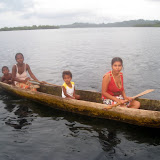
From Crawl Cay we sailed on to Laguna De Bluefield, where Guaymi (Ngobe) indigenous people live on the edges of the water seemingly on little money and subsistence fishing. When entering the anchorage at Punta Allegre the friendly people came out to talk and greet us in their family Cayucos.

After two nights we moved on to Laguna De Chiriqui and the mighty Cricamola River. In Irish Bay where we anchored in a protected mangrove cove, the water was brown with run-off from the many rivers and we plogged up our watermaker (temporarily) and actually had to use bug spray to repel the no-see-ums as the anchorage was dead calm. It made us wonder how the natives could stand to be there all the time, despite the prolific wildlife and fish.

We had to use the dinghy motors on full throttle to move up the Rio Cricamola , and what a grand vista with mountains in the background, tall Kapok trees and foliage, banana plantations and indigenous villages one, two and three along the muddy banks of the swiftly downstream moving river. We had a great trip looking for birds, visiting with the villagers at village one and purchasing the woven carrying bags the people are famous for making. I’ll let the pictures tell the story!

From Laguna Chiriqui we gave it our best shot to sail or motor sail the 35 miles back to Bocas taking the Split Hill and Sumwood Channels between Chiriqui and Almirante. That was an adventure in navigation! The ferryboats take the channel regularly, but it is not well marked. We knew it would be the shortest way and should have plenty of depth if we could find the channel.

Our choice of path was somewhat complicated by Windsong’s mechanical issues. At the end of our trip to the Dark Lands, Jamie’s main shaft had broken off, dropping his propeller somewhere in the Bocas anchorage. He was totally motor-less and showed his sailing skills as he tacked his way back to Bocas with his dinghy strapped closely to his hull providing some propulsion but sucking up his gas.

The day was overcast and the water a dark blue so visibility as regards the shoals and shallows was impossible even when perched on the boom. Lucky for us Steve was aboard the boat as he and I spent hours in the dinghy using the portable depth finder sending the path to Dan who drove the boat with a few quick reverses needed as we measured the water -from 19 feet to 5 feet in the space of a boat length. Tregoning and Windsong relied on our information to safely negotiate the tricky channel through the mangroves and out into the bay.

Sea Star, using motor as required, arrived back in Bocas first and provided the only dinghy with gas to go for Pizza as Tregoning, followed by Windsong in the dark, arrived safely back at the anchorage.

The next morning we had a goodbye breakfast together and Steve was on his way home to Greenfield, MA and his plumbing job. We were sad to see him go. There was so much more to explore in the Bocas area. No wonder so many cruisers have purchased property in the area and moved to Bocas permanently.


Here are 100 pics:

Steve's adventure

Bocas del Toro Tierra Oscura (the Dark Land). Laguna Palos July 1-4, 2009

Bocas del Toro Tierra Oscura (the Dark Land). Laguna Palos July 1-4, 2009

We were having a great time in Bocas Town but exploration is the name of the occupation of cruising. Dan was reading the guidebooks and decided that we should check out a new area, Laguna Palos, in preparation for possible adventure when our son would visit. Tregoning and Windsong were game to go also, and another Island Packet couple, Valma and Ed on Navy Blue, and so we set off on the short trip, about nine miles from the anchorage-but really into another world.

Our course was west to Juan Point, then following the west coast of Isla Cristobal in Bahia Almirante until we came to the three unnamed mangrove islets that are the markers to turn into Laguna Palos. On the way through Almirante, our slowly moving sailboats were approached by men in Cayucos who sold us large lobsters! We had just passed a school on our starboard and saw the children in their white shirts and black pants or skirts paddling their Cayucos all around us when we saw the entrance. They stayed right at the sides of the boats, trying to hang on, while we tried to anchor. To actually enter the anchorage, the best information we had is the guidebook -The Panama Guide- by the Zydlers, but at times the uncolored sketch charts are difficult to interpret. Additionally we used a Raymarine chart plotter and paper charts and as all the material warns- we inched our way in slowly and kept a sharp lookout for coral, shoal areas and an eye on the depth until we anchored close to the shore in front of a native house in the magnificent lagoon.

It had rained as we approached but the clouds had cleared and we were taken by the beauty of the place called Tierra Oscura, meaning The Dark Land. Now to explore and bird watch. The Zygler guide showed a trail to the top of a mountain and we were all game for that. Dan and I grabbed binoculars and dressed for a walk and skirted the edge of the mangrove lagoon seeking birds and a place to tie the dinghy and go ashore. To our disappointment, at regular intervals around the lagoon, we saw hand-lettered signs that read “privada propiedad”, so we kept circling the edge in the dinghy. Quite suddenly but very slowly an old man in a cayuco approached us and asked us in English where we were from and was very friendly. As we talked I said we were looking for a path up the mountain, but all the signs said the property was private, so we were not going ashore.

Well- we had met Valentino Reade Smith, a man who could trace his ancestry back to the time of the slaves and who was now an owner of the entire property his grandfather had acquired, who, with his brothers was farming, fishing and raising high quality cattle. He was happy to bring us ashore and guide us around his property, machete in hand and wearing rubber boots, saying the signs were hanging just because all the others have them and they don’t mean a thing to him. Walk! Enjoy! He said there were many bird varieties available and as Dan and I, and by now the other boaters, tried to keep up with this spry older man we were told about the various species of lime tree he grew, fruits, banana and taro plants, cocoa and cacao, breadfruits--- and the stories he recounted of the older days, his grandfather and father and their folk wisdom were fascinating! He sure had us looking DOWN when he recounted the many varieties of snake he had witnessed on the property as well as animals and birds.

He told us there were Tommygoths, vipers, coral snakes, Fer de Lance and other snakes. They had bit and killed cattle! He told us how his grandfather knew that the worst time to be bitten was three days before and after a full moon as snakes have greatest venom then. He told us there were once very large sharks in the laguna and attacks on swimmers regular, but no more. He said his new neighbors, the Indians, kill anything and there are fewer animals; monkeys, iguana, caiman and fish. But he was born on the property and, although he goes to Bocas regularly, he wants to die there. His children live in towns around or far away. From what he said they have varied occupations but have been well educated and a few are scientists and professors.

We walked the mountain trail from his property one day, and the property the next morning. The hike up the slippery trail was somewhat difficult. As you tried to follow the path used regularly by the locals, quiet men in rubber boots carrying machete came up quickly behind you and passed with a quiet, Buenos dias. The foliage was thick and at places we saw leaf cutter ants and army ants about their business. I did not climb to the top. The path was getting steeper, the trail muddy and the time was late, I thought, for the return trip, then at one rock I needed to cross was a huge-HUGE buzzing bee and I didn’t want to go on. I turned back where Dan and Randall were walking more slowly birdwatching, and watched Randall trying to descend the path wearing flip-flops!

Laguna Palos was an adventure and a very special spot. Valentino felt the birding wasn’t that great on the morning he guided us but we saw Red-fronted Parrots, and a Lineated Woodpecker and many others such as Toucans and Oropendulas. Valentino is one of a kind! We thanked him for his friendship by brownies and a book and prints of a few pictures and made our way back to Bocas anchorage by the Saturday, July 4th cruiser potluck organized by Suzy and John on the trawler, Cabaret, held at the Calipso Cantina.

Here are 28 pics:

Tierra Oscura walks

Monday, July 13, 2009

Bocas del Toro, Panama June 19- July 1, 2009

Bocas del Toro, Panama June 19- July 1, 2009
All too soon Sea Star and the others left Little Corn Island. In the morning when the wind was just right as forecast, 15 knots, we were merrily sailing along toward Panama. At exactly 12:00PM the wind switched by 60 degrees and then straight on the nose, then shortly after that the wind simply fell out and died. We needed to arrive in Bocas in the daylight and so on went the engines and we motored on the first three foot swell, then calm sea trying to maintain our 5.5-6 knots per hour to arrive with the light needed to enter a new harbor.

Dan had decided on the Bocas del Drago Channel entrance and we made good time but impatiently watched the depth finder to note we were in very deep water and off soundings. When we were closer to the channel we could just pick out the expected landmarks- a flat rock called , a pinnacle rock and a small rock island. These landmarks brought us to the clear channel and the red and green channel markers towards Isla Colon and Bocas del Toro.

We were going to have to share the channel with a large cargo ship that was steaming in at about 18knots. Dan called him on the VHF and confirmed that we would be staying to the left of the channel and the ship moved closer and closer. Just as the huge ship neared the channel curve and narrows, he did a U turn! We figured out by listening to his communication that he was awaiting a pilot boat to guide him in and he had been told to stop. The fast change of direction certainly surprised us, but all was well as the pilot met the ship and they passed us inside the channel but leaving no wake to speak of.

Ahead of us on Isla Colon we saw a few homes and the raised stilted buildings of Bocas del Toro where, after we turned in, we could also see the masts and boats at Bocas Marina and in the anchorage near the marina where we were heading.
By now we had put up our yellow “Q” flag to notify the Port Captain that we were entering the country of Panama.

We were safely anchored and of course exhausted but the officials needed to board us. It was relatively painless but more expensive than written in our guidebooks. Four officials arrived at Sea Star by launch , two men and two women. The quarantine officer checked that we were not from an area of the new flu such as Mexico, and asked us about our health. He took Maggie’s papers, $15.00 for her permit, there was a boat inspection-but no one entered the cabin, an agricultural inspection-but no trash or food was checked, and immigration gave us a 30 day visa for the country that could be extended to 60 days. The Port Captain checked in the boat by length and then the group left with our passports and $123.00US.

Later in the day we were to pick up the passports from the Port Captain where we paid $69.00 more for the cruising permit, $20.00 for something else important. The following day we walked across town to the airport and met with the “migration” officer with some stamps purchased at The National Bank for $15.00 per person so another $30.00 for us. Our receipts in some cases did not match the amounts paid to the officials. The story was we would receive the receipts when we went into the office, but in two cases that did not occur. Our poor Spanish may have been the cause of our not questioning the prices.

Anyway, entry completed and prices forgotten for the moment, we walked and explored Bocas Town, finding Lily’s and Pirates to tie the dinghy and looking for the groceries, hardware stores and shops that make Bocas a pleasant place to anchor and a base from which to locate anything you might need from David or Panama City. I unfortunately had lost my new tooth repair done in San Andres and I found a local dentist in Bocas, Dr. Wong, who spent quite a bit of time and effort refilling my tooth.

Our first meal out was Happy Hour and Pizza at Wari Wari,an open air restaurant with black and white décor reminiscent of totem poles and the popular red, green and yellow trim of the Jamaican rasta- on bamboo. Very interesting. Another day we ate breakfast at famous Lily’s, home of the “Killin’ me Man” hot sauce, a wonderful fruit salad to start and eggs, toast and great Panamanian coffee. Then it was a wonderful restaurant blitz..Pirate’s has great international style foods, Lemon Grass for Thai food and the Calypso Cantina Restaurant and Bar at Bocas Marina serves excellent food. It’s a very popular place with cruisers to play volleyball and relax out of the sun each day. We had a blast playing Trivia there one Thursday night and a cruiser planned a Fourth of July party there with a potluck supper and lots of fun with forced activities like Limbo and Girls Sing.

Here are some Bocas Town pics


Bocas town


One really interesting visit we had was to the Smithsonian Research Center. To get there we took a taxi out of town to Sandfly beach where the Center has special tours a few days a week. Our guide, an ex-pat living in Bocas and two native young scientists walked us around the grounds. The three toed tree sloths were close up and personal, yet wild. The guide discovered them hanging over the road when we had all begun to leave and called us back to see them.

Below is a little movie of moving mother and baby sloths.

Here are pics of the Smithsonian Research Center in Bocas


Bocas del Toro OL


There are cruiser nets that include Bocas. A VHF net on channel 68 at 8:00 daily and the Southwest Caribbean Net on SSB at 8:15AM. A problem we are having is we can no longer receive the weather reports from Chris Parker whom we relied on father north. While we are here in Bocas Dan has done the research and ordering of a new battery bank for Sea Star, a major purchase, but we can’t seem to keep a charge in the current AGM three year old batteries, so we must replace the seven of them together. At least everyone says, “anything you want you can get in Panama City.” He’s ordering the batteries through an agent and from Miami. Someday they will arrive by ship.

More to come on Bocas as we explore and travel. We are expecting a visit from our son from the States on July 5, so I’m sure we will do some fun things to write about!