Tuesday, January 19, 2010

RESTING AT CLUB DE PESCA, Cartegena, Columbia January 19, 2010

Club de Pesca, Cartegena, Colombia January 22, 2010


January 12th, Sea Star entered her new temporary home in beautiful Club de Pesca Marina. We are stern into the concrete fixed dock and tied to two pilings from the bow. We are in the marina for a few weeks to have Sea Star, who was looking a bit grungy, cleaned as there is fresh water and electricity available here. There are industrious workers who clean and polish very nicely. The man we hired, Estuardo, has children in the Univercidad de Cartagena and works for a modest amount per day. Sea Star has not looked this clean and shiny outside since we stopped in Maryland at Gratitude Yachting Center. We have other things to work out, too. Should Dan have arthoscopic surgery and if so, where?
Where will Sea Star sail to next? and do BMW motorcycles have more fun? These issues will be discussed in later postings, maybe.


We continue to enjoy the city sights, sounds and activities. There are always festivals and fiestas in Columbia. One of the larger ones is later next month in a city named Barranchilla. It's supposed to be a wild three-day festival. We think we will go for a day as it is obvious that every hotel, motel (we've learned about them), and Bed and Breakfast type place has either been priced WAY out of our league or was "unavailable" for the time of the festival. What the proprietors seem to do is not take reservations, and then just charge whatever price they want to to some lucky hotel seeker. I'm really looking forward to a great parade and show and a long day!

Throughout the month of January there has been a fabulous Music Festival, a classical music program with the theme “La Magia de Mozart”, involving entertainers, many well known world-wide. The concerts were held in or near magnificent architectural backdrops; churches, halls and in beautiful outside venues in the Walled City. A lovelier backdrop it’s hard to imagine.

San Pedro’s Plaza includes what used to be San Pedro’s convent, the beautiful church, what looked like some apartments above a large restaurant restored to Colonial splendor, and in another building on the other side of the square is the Museum of Modern Art. The square still contained its Christmas lighting and during the concert the video recorders and perhaps TV cameras provided plenty of light to see the performances as well as the crowds.

The concerts were magical! Dan and I attended one of the 10:30 at night ones that included famous Columbianos; a guitar soloist Ricardo Cobo, followed by the Bahia Trio with a lively Caribbean beat, and a rowdy, fun, small orchestra of eight called Porto Candelaria who actually played (among other instruments) the plastic bottle! With the encores the music went on to 12:30 AM! Remember-cruiser midnight is 8:30, so we were tired but that was a January highlight for both of us!!

At other concerts, a group from the London Symphony has performed as well as Sahnghai Quartet, celloist Alisa Weilerstein, violinist Bella Hristove and many others, for free or close to free.


The last night of the festival I decided I did not see as many of the performances as I had hoped to. That night, with a friend, I attended the Mozart Requiem,K 626 with four wonderful soloists and the London Symphony. As before there were plastic chairs, maybe 500 of them in the square totally filled with concert goers, mostly Columbianos, and hundreds more of us hoping to hear the concert were standing next to the fencing around and behind those seated. The people were dressed in their finery and all, especially the women, looked gorgeous and entry was free.

The Requiem music was very moving, but the irrepressible spirit of Cartagena kept popping through in the more subdued parts. There was a Marimba Band with drums and flutes marching in a nearby street on one side of the open square where the outdoor concert was on—then on the other side a salsa club’s music was spilling into the street. The professionals never lost a beat nor let their eyes wander to the distractions. The piece was strong enough to overshadow the other sounds for the most part, and the eleven bongs of the church bell added to the dirge at 11:00PM.


From our berth at Club de Pesca it is an easy walk to the Old City and every time I go, there is more to discover. There are vendors, exclusive shops, at least four museums (we haven’t had energy to hit one yet), exciting plazas and restaurants of all types and prices. Cartagena is known for its emeralds and as you pass store windows, the jewelry gleams. We did explore one museum where very old emerald pieces were displayed as well as cave walls recreated so that the visitor would get the idea of how the various kinds of emeralds are mined.

There is an interesting mix of old and new here. Along the one half mile of waterfront is a meandering brick walkway where people stroll and powerwalk or lounge on the park benches during the day and later the wide walkway is use for running and in-line-skating classes for the kids, and baby stroller walking. In the evening there might be street music for the adults that we can hear from our boats. This area is new and park-like and contrasts with the streets of the Manga area where the marinas are located and we mariners are cautioned about pick-pockets and worse. We have not felt in the least threatened but about once a week a dingy and motor is stolen and you hear of some crime.


The brick walk described above meanders along the Porto de Cartagena, the cruise ship tourist stop, the anchorage to Club Nautico and through a city park, to an old fort finally arriving at Club de Pesca-


Quite near, a short taxi ride that costs $5,000 pesos-about US $2.50 there are two malls to rival those in the US where the shopping is great and the food court, intriguing. We were able to see the new movie “Avitar” in 3D. Another of the areas of Cartagena is Boca Grande where the high rise buildings you see in my pictures of the anchorage are located and many rich Colombianos have condos. This is the area where cruisers often need to go for Doctor visits. There are modern dentists’ offices, lots of specialty doctors such as plastic surgeons, orthopedists and laser eye clinics. Many cruisers feel the out of pocket cost is manageable and the care is superior to their US facilities, so they chose to have their care in Colombia. We are all astounded when the doctors freely give out their cell numbers and when you call- they actually answer and speak to you directly to make appointments and such.

Some things are expensive but some are very cheap. Cruisers here are getting all kinds of work completed as needed for reasonable prices. Some have added inside woodwork in boats, hard dodgers, or canvas projects such as biminis. Some have pulled their boats out of the water and redone the hulls or painted, others have pulled all their chain and anchors and regalvanized them. We haven’t needed too do much. We have had some electrical work completed, replacing the cable up the mast to install our new radome, replacing our VHF radio mic in the cockpit and installing a remote for the Sirrius radio- all due to the lightning strike back in July.


What is next? We’re not sure yet. We’ll be here a while and perhaps go on a trip to a lovely island where we can SWIM again, the Rosarios. At the Rosarios you can snorkel, see an aquarium that is reported to be great and there is an aviary that has many species of birds-so we’ll see when we feel like getting off the dock and going! It’s fine for now while we sort out some things that still need doing. Meanwhile our Spanish is improving a bit-geeze it's hard work to learn and retain a language. At the dock we run our air conditioning. It's hot in Cartagena during the day. The boat heats up until breathing becomes difficult, then we close up and put on the AC for relief. Later in the day the breeze comes back and the nights are usually comfortable to sleep.

Here are some pics of the activities we have been doing lately. Sorry about the quality of some.

More sights - Cartagena

Monday, January 4, 2010

AFTER CHRISTMAS & NEW YEARS January 4, 2010

Christmas came in Cartagena and the bangs and flashes were seen and heard all the way to Ano Neuvo and beyond- at 2:00AM and 3:00AM this morning, January 4, intensive fireworks were heard from the town near the anchorage yet again! I think the first fireworks to welcome Christmas were on December 7th.

Leading up to Christmas there were the fireworks, and beautiful light displays containing pouffy ribbons and bows and lighted blow-up characters that we walked and saw, especially in Old Town. The people were very friendly and jovial, (maybe a tad enubriated) everywhere-though liquor is expensive here.

Cruisers did their part to celebrate and uphold their home traditions. Some cruisers had family or friends visit over the holidays but most of us just got together and had fun.

On December 19th there was the Christmas Ball with DJ music and an attempt at Salsa dancing by Gringos in a converted hamburger haven-you'd be surprised what a little green cellophane can do for a place!

On December 24th Sea Star got together with friends on Cabaret, Foreiner and Endorfin for a Christmas buffet on Cabaret's upper deck.(they're a motor trawler) I made artichoke-cheese dip and a pork shoulder I thought was a ham to contribute. (Damn, I really have to learn more Spanish)

December 25th at 4:30PM we were on our way to the Christmas dinner planned and organized (kinda like hearding cats!)by again, Cabaret.
Since the Club Nautico did not have a space- or a place- remember my last set of photos of deconstruction? Suzi and John found a place at a backpacker hotel and the planning began.

The food cooked and brought by the cruisers was excellent. There were many kinds of salads and vegetables: my green lime jello salad, tossed salads, Waldorf Salads, tubuli salad, yams, sweet potato, squash, mixed brocalli and califlower. Dan and I served maybe 75 people. I served the mashed potatoes. Each cruiser was to bring food for 15 people, so all I had to do was shuffle pretty bowls. Dan and Bill had to serve turkey. They were told not to honor requests--but everyone got what they wanted and there was enough for seconds--then free for all!

After dinner part of our entertainment was a "treasure of the bildge" gift exchange. Cruisers grab something from the boat, wrap it and hope somebody takes it home, so it's not on your boat any more. People are given a number when a gift is put on the table. Numbers are drawn at random and when your number is called you can open a new gift from the gift pile or grab one someone else has opened (and maybe stashed away).

My first choice was some DVD's, then it was exchanged for vanilla body lotion, but finally I came away with two brass hooks to install on Sea Star and a darling little girl was thrilled to open my donation of a red dish towel and Christmas snowman pate' spreader! The gift everyone wanted was T49, a spray can of corrosion block, or a 12 volt clip on cabin fan. The last gift that noone wanted and so it caused lots of trading was cigars! A good time was had by all who understood the game or played fairly. Those EU sailors really didn't know what hit them!

The rest of the evening we tried a Christmas sing along and a pair of cruisers who play instruments and sing well, entertained us.
Others who did not sing so well but did have the urge to belt it out were passed the mike. Suzi from Cabaret and Kerry from Coconut teamed up on Proud Mary, Miguel who hadn't touched his guitar since the sixties tried to remember the chords to folk songs and Mark played bongos. Then we all grabbed out still unwashed dishes and hailed taxis to return to our boats.

As for Christmas morning when Santa should have come, well.. what he brought was lovely barnacles! Neither head (toilet) would hold its vaccuum charge. It required Dan going into the not so clean water with a screwdriver to push off the little devils, and cleaning the discharge where barnacles had grown and plugged the outlet.


So.. we had the boat apart anyway and started running the cables for the new digital radar and Clarion radio remote that had been damaged by lightning way back in July. The path the wires had to be fed through by a metal wire snake was from the pedistle outside, into the lazarette, down into the aft cabin and under two lockers, over the engine compartment, under the floor near the sink, through two totally stuffed compartments under the sink and under the generator and up through the shelf, into the electronics boards. This took two full days and the sorting of those lockers still isn't completed!
There are a few pics of the condition of our boat on Christmas day!

Ano Neuevo is as important a time in Colombia as in the US. We had looked into going out to a restaurant where there would be local music. There were many places advertised but the cost was as much as in the US probably $150.00 a couple or more for the evening. Our young twenty-five year old Spanish teacher suggested that we all visit his home town of Turbaco and go to a bullfight, have a wonderful dinner, listen to live music and attend the yearly fiesta on the Plaza and all this would be less money and more fun. We were certainly game especially when Oscar suggested he would meet us and get us on the correct bus. We decided to stay the night as there were hotels in this town of 100,000 people.

And that is what we did! The bullfight movie shows some short clips I took and meshed together using a program. I was entranced by the beautiful children. The parents seemed very indulgent and the kids were fed and bought anything they wanted. Of course there were charactors in the rickety and bouncy stands and men went by and up the stairs constantly hawking food, beer, bottles of rum, sodas, cowboy hats and woven blankets to shake and wave! The band played, the townspeople (men) went into the ring and all hell broke lose. Whose counting-but we saw at least one major goring and a few run-overs. Here the bulls do not die-they are run into the ring for about five minutes so we saw as many as 10 bulls. A few were stuck by the long lances of the horseman and they bled but we were assured they were all ok.

After the fight we spent the evening in the Plaza. It was a relatively early evening back to our wonderful hotel as the Columbians go home at 11:00PM so as to spend the midnight time with family, at least in this town.

The last set of pics is of the Casa de la Abuela- "Grandma's House" with it's wonderful view of the fireworks all the way from Cartagena to Turbaco. The Casa had its own zoo- so that's where the animal pics came from.

HAPPY NEW YEAR TO ALL

Christmas and New Years

Wednesday, December 23, 2009

CHRISTMAS IN CARTAGENA- Dec.23, 2009

Wow! It's nearly Christmas. We heard that Christmas in Cartagena would be special and we are finding out that this is so! Enjoy these pictures of what we are seeing!

We are living on Sea Star in the anchorage in front of and South of Club Nautico. Rumor is that the owner of Club Nautico supported the wrong candidate for Mayor (the one who lost) and has had her renovations stopped. There are no facilities and services available. Boats can be tied side by side and like a "med mooring" they are faced bow in and the stern is held by lines tied to blocks under water. As of three days ago there is one shower. We are carrying our water as the harbor is too dirty to make water. It might ruin the diaphram in the water-maker.
Don't foget to return to blog for more after each slide show or movie.

Cartagena- where we are


The next set of pictures show some of the people and activities that keep us so very busy- beside fixing the necessary things on Sea Star like the radar, and brand new VHF radio.


Cartagena- What we do.


One night I went to a ballet recital. It was wonderful-lots of fun.


At the Ballet


Now just enjoy our pics of Cartagena. Dan and Laura, the daughter of a friend who was visiting Navy Blue both enjoy photography. One night we strolled through the Old City taking photos.

Cartagena before Christmas


We hope you enjoyed our walk through the Old City. See you next year!!

From Christmas Card

Wednesday, December 2, 2009

CALM PASSAGES AND OTHER TYPES, TOO November 20-30, 2009

CARTAGENA, COLOMBIA November 30, 2009
Dan has wanted to see Cartagena for years; maybe because of reading wonderful things in “The Log of Ithaka” by Bernadette and Doug Bernan, or our cruising friends on Pizazz, who really loved that city and all it had to offer. Now that Dan and I have visited some great places in the Northwest Caribbean arriving in the San Blas again, it seemed like a great time to continue on to Columbia. Dan really wanted to go, but I took some convincing. The choice was easy, really. As we travelled we met many cruisers who were returning from or planning their return to Cartagena. There was not one negative report. Cartagena, it is said,”is lovely, safe and has lots of wonderful things to see and do. Christmas time is magical !”

November is a moving month in the Caribbean because as the rainy season ends, the weather can change to windy with storms and thus higher seas at any time. Colombia already generally has forecasts for seas at least 6 feet and the usual conditions seem to be 7 to 8 foot seas. Most cruisers want to be in Colombia by mid November. We visited Massachusetts and returned to Panama on November 16th, so we felt we needed to move on quickly!

As I mentioned in other entries we left our long time traveling companions and friends on Tregoning in the San Blas two weeks previous. It was difficult to say our good-byes and sail away from them as we realized that we share many interests and had been daily companions since George Town in the Bahamas! At Shelter Bay we met a friendly couple on an IPY 37, Jay and Barb on Jupiter’s Smile, who wanted to leave, as we did, for the San Blas. Our two IPY’s headed out of the marina on November 20th at a break in the constant rain that had been beating down on our roofs and canvas for days.

It rained all through our first traveling day and at night but we spent one moderately comfortable night at anchor in Playa Blanca, scraping the renewed barnacles off our boats, and where we met a resident named Angel, before moving on toward the San Blas-again in the rain.
Our progress was inhibited by wind on the nose so we had to motor sail, and the constant rain had washed HUGE trees, logs, thatches of entwined branches and various debris into our path. Well, perhaps because the weather was s000 good and our trip wonderful- by the time Jupiter’s Smile had checked into Porvenir, they had also checked out again and decided also to travel on to Cartagena. Hooray! We had a buddy boat to increase the safety factor for both of us. The importance of which became very clear later in the trip. We spent a night in the West Lemmon Cays, a night in Nargana, where we revisited Nali’s Restaurant and introduced Sammy to Barb and Jay.

Our next night was spent only 20 nm from Nargana, at Snug Harbor, further to the east. We found the anchorage to be lovely and inviting. This protected harbor is near the Panama mainland. There is a group of four or five small reef protected islands with the names Yuala, Apaidup and Ogumnaga where friendly Kuna Indians paddle their ulus selling vegetables grown on the mainland, Kuna bread and other offerings. There were other boats at Snug Harbor and some were waiting for a weather window to Cartagena. Dan and Jay agreed that the next day, Thursday, Thanksgiving Day, seemed to look good for a passage, although not perfect. The next chance to leave was then somewhere off in the distance and so on Thursday we left at 6:30AM. We were not to be alone. There were six other boats from that anchorage who made the same decision.

In preparation for our passage I had made some chili, beef stew and a few other goodies to avoid the need to stand in the galley during possible rough seas.
Dan had changed our fuel filters checked the engine and steering and we felt we were as ready as possible for our 170 nm passage, figuring 5knots per hour we were looking at 34 hours on the sea. We had already determined from the forecast that sailing would not be possible. The best we could hope for was motor sailing and low windspeed so the boat could make progress against the wind more comfortably.

We moved along fine for two thirds of the trip at about 5 knots experiencing 4 to 5 foot seas, then 6 to 7 foot seas as we approached closer to the Columbian coast. By that time our group had formed our night formation where we could see each other’s lights. Jumby was far ahead and out of sight, Sea Star flanked by Jupiter’s Smile, then Tempest and Pelican’s Flight. Mariposa was slightly behind our group. The group had maintained chatty radio contact as much for entertainment and to keep the watch person awake as for safety. Infinity, a fast J boat, we had enjoyed seeing coming up behind our group earlier in the afternoon showing her lovely spinnaker which she changed when night fell, as the seas were building a bit more and the wind was "on the nose".

The seas were becoming more uncomfortable; the trip required motor and it was very late into the midnight to three watch when the call was heard; a Pan Pan call on VHF radio that says a boat is in serious trouble. Jupiter’s Smile was the only boat to hear the distress call on the radio. Jay responded by contacting the boat by VHF radio to find out a cruising couple had been bailing their sailboat, Kersti, for quite some time and they felt she might be in serious danger of sinking!

What to do? Any mariner is bound by law and the law of the sea to respond when a call for help has been received. No one else, such as a larger ship, had apparently heard the distress call. Soon Jay had turned Jupiter’s Smile to return the 9 nm upwind- back- to offer assistance. When the other boats were alerted to what was occurring, Maraposa and Pelican’s flight started to the scene with the powerful pumps they carry on board for emergencies. Infinity tried to contact the people who were expecting them on shore to get an idea of what might be a good solution if the issue was not life threatening. Sea Star contacted Tempest who had some emergency phone numbers for the US Coast Guard in Miami and Key West, and used emergency SAT phone to make contact with the US Coast Guard and eventually the Columbian Coast Guard.


RESCUE AT SEA
I wish I could report a happy ending to the story. The owners of the sailboat, Jeff and his wife Ruth worked valiantly to keep Kersti afloat and sent out a radio distress call; bailing constantly while trying to motor toward Cartagena where the Colombian Coast Guard, we thought, was going to attempt to meet them. Meanwhile, an attempt to pass a pump to them failed as Pelican’s Flight’s pump jumped from the dinghy in the high seas, now 10 to 12 feet and seriously rolling all the boats, and the dinghy flew by and was lost.

The US Coast Guard set out from 175nm away. They said they could not be on scene for at least 2 ½ hours and they could not deploy their helicopter off the ship until they were 75 nm away. The Colombian Coast Guard was called again. With sinking hearts we found they had not deployed their boat. They felt the seas were too high for the boat they had on hand and had sent a reconnaissance plane to check the scene first.

Meanwhile it was becoming apparent among our five boats that any rescue would be up to the sailboats on scene. The authorities kept asking for information updates; which meant that Jay who was having all he could do to drive into the crashing waves needed to talk on the radio to Dan so he could convey the information, to Tempest who was relaying information and suggestions to the crew of Kersti, who also were very busy. What were the new coordinates?, What color was the sail boat? Were the people wearing life vests? How do you spell Kersti? What is the radio’s MMSI number? Do they have a cell phone?

After the problem with receiving Pelican’s Flight’s pump Jeff was concerned that other boaters should not put their lives or boats at risk and gave up on trying to receive another pump that Maraposa offered. He then felt he would do all he could to move towards land while waiting for the possible help to arrive. Within an hour Kersti had taken on so much water and was so bow-heavy the couple decided to get into their life raft and abandon their home of six years. There was just nothing else to be done.

With great difficulty the couple placed a few belongings in their life raft and climbed in themselves while Jay, made a pass by the life raft and Barb, who had become quite sea sick, received it -being out on the deck in those huge seas. Jeff and Ruth and their few belongings were taken aboard Jupiter’s Smile; they were now safe themselves but they did not know the fate of their beloved Kersti. Dan, Sea Star had by now arrived on scene also, notified the coast guards, US and Colombian, that a pick-up had been made and called off the rescue. The distress call continued every 5 minutes until 10:15AM.

All of the boats now steamed toward the closest port grateful to have not required the skills of the Doctor aboard Tempest; the Bay of Cholon still eight hours away where we were guided into the shallow channel by Richard from Tisha Baby and all were treated to food prepared by other cruisers anchored in the Bay who had been listening to the radio transmissions and were anxiously waiting our group’s arrival. Arrangements were made on another sailboat, Glide, to get Ruth and Jeff to Cartagena where they could begin to decide what was to happen next.

It was the end of a very long day. We had set out at 6:30 AM from Panama. Jay and Barb turned around somewhere around 2:30 AM and with the sailboats Mariposa, Tempest, and Pelican’s Flight stayed with Jeff and Ruth until the conclusion at 8:30AM. Sea Star arrived around 6:30AM and while anxiously waiting and informing the Coast Guard of events on scene, took some pictures. We put anchor down at about 4:30 PM.

It is possible that the outcome would have been the same even if Jeff and Ruth had waited in the life raft for Coast Guard rescue. It is not certain. Apparently the US Coast Guard arrived on the scene sometime after we all headed to land and checked for the sinking sailboat, but saw no evidence of her. Here in Cartagena Harbor where huge cargo ships have been arriving and departing almost constantly, you have to wonder where they were that night. In the harbor we anchored quite near the impressive US Coast Guard cutter and saw the bright red rescue deck helicopter. It’s nice to know that in the states we have such resources. The Columbian Coast Guard apparently did not have a ship to send to the scene. Dan had great difficulty in communicating with them (language) and they didn’t appear to grasp the severity of Kersti’s situation or they just couldn’t help which was frustrating to us.

Jeff and Ruth still don’t know what sunk their sailboat. They have taken an apartment in Cartagena and may be waiting for some word of salvage of their boat; although it went down in very deep water there are some shoals near. They appreciate all the assistance given by the cruising community.

Jupiter's Smile, Pelican's Flight, Tempest, Infinity, Jumby, and Sea Star among others enjoyed our stop at the Bay of Cholon where the local boaters introduced us to the small town of Barru. A few days later Sea Star moved on to Cartagena.

click to see photos of Snug Harbor, Cholon Bay, Columbia and Barru
Cholon Bay-OL


Click here to see the rescue of the crew of sailboat Kersti

Rescue of Kersti
https://picasaweb.google.com/chepar50/5410811420640763969?authuser=0&feat=directlink

Now for some pictures of Cartagena anchorage and the Port of Cartagena.

Port of Cartagena OL

Friday, November 20, 2009

A Week in Massachusetts November 5-16, 2009

Logan Airport- November 16, 2009

BACK TO PANAMA

On November 5th Dan and I left Sea Star at 2:30AM and were driven to the Tocuman Airport by Tom from Shelter Bay Marina where we her in the capable hands ..of another cruiser, to arrive for our 5:30 flight to Boston. Now after what felt like a whirlwind and at times grueling trip- waaay too short- we are returning today to Colon, Panama, with the plan to soon continue on to Cartagena, Columbia via the San Blas Islands.

Our trip to Massachusetts was productive as Dan needed to keep his plumbing and electrical licenses current, and it was refreshing to visit family and friends and “catch up.” After a safe and on-time arrival in Boston, we got lost driving to Tom and Anina’s apartment in Cambridge. We finally arrived to a great 10:30 PM dinner, a little conversation, and headed toward Greenfield the next morning.

Luckily, Steven, our other son, has a nice apartment where we could stay while we visited my sister, Barb, my nieces and their families and some friends during the week, enjoyed special times with Steve, reacquainted ourselves with Maggie, the ex-boat cat, (she’s happy and solidly on land), did a quick tour of doctors and dentist and spent a day at Defender Marine in Connecticut selecting needed boat equipment.

We then zoomed back to Boston where Dan took his second class and Anina and I made pierogis, a tradition in our family that she wanted to master. We walked and talked, opened packages to take back to the boat, bought Christmas gifts, repacked -trying to keep the bags under 50 lbs (American Airlines let the last one go at 51 lbs) returned the rental car and we are waiting at American to get on the plane as I write this!

The weather was cool and a little rainy, I caught a cold, Dan had a sore knee but we had a great time and hope all the people we asked can make the time to visit us on the boat! In the confusion with all the bags and boxes I misplaced my camera so I have no new shots to include.

note that Tom put a new entry picture for our blog! It's also the shot we use for our boat card (like a business card) The shot was taken at the middle of our Newfoundland trip at Aviron Bay on the south coast back in August 2008.

Sunday, November 1, 2009

In and out of paradise! October 30, 2009

Leaving the San Blas Islands behind October 30, 2009
In and out of paradise!

Sea Star backtracked to the West Lemmon Islands yesterday to stage for our passage to Linton today and then Shelter Bay Marina. We found the San Blas as lovely and inviting as it was eleven years ago- and are sorry to leave so soon.

We entered Kuna Yala and spent our first nights’ anchorage at the West Lemmons, where with Cabaret, John and Suzi, snorkeled a sunken ship in only 20 feet of water at nearby Dog Island, marveling at the colors presented by the growing coral reef. Also snorkeling were guests from a Kuna hotel on the island. They seemed to be Panamanians and some Columbians on vacation enjoying the warm sand beaches and crystalline waters. Here we were prepared fully for snorkeling; lycra suit encased and full fins, mask and snorkel. Seems all you need to swim is a tiny bikini if you are on vacation. I wondered if the beautiful girls would be covered with welts from the corals.

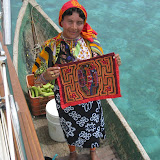
As new boats enter the anchorage the Kuna Indians in their sailing Ulus approach to tempt with lobster, crab, sometimes fish and always beautiful handcrafted Molas that the women of the San Blas have been making for generations. Two of the best known Mola makers are actually men. One is Venancio Restrepo who was first to come to our boat in the Lemmons and another named Lisa who is a transvestite, common in the Kuna culture, who wears her hair long and dresses in colorful clothing. We remembered having bought Molas and taking a river trip with Lisa on our last trip to San Blas.

To make a Mola colorful cottons of various colors are layered, as many as six or seven layers and cut to allow the design to immerge through from the color chosen for the last layer to the first or the top color. The best made Molas are always hand stitched with neat and tiny stitches taking the maker three months or more to achieve the desired design. The maker or his/her emissary bargain at the boat with Molas strewn on the lifelines and deck for effect and to sell at the best price a cruiser will pay. Many are lovely, all are colorful, some of traditional design and others of colorful birds especially desired by the tourists who come to Carti by cruise ship.

The next day Tregoning who had been delayed a day by engine trouble in Linton joined us. By afternoon they had checked in and returned to our new anchorage in the East Lemmons, a turquoise paradise between two inhabited islands, where we were approached by our second set of hopeful Mola saleswomen. They were able to sell to Tregoning-the newly arrived boat.

Soon we moved on down the chain of over 365 islands with incredibly complex names to Kuanidup in the Los Grullos group just a few miles away arriving in 20 knots of wind and low visibility to avoid the surrounding reefs. After finally achieving a safe anchorage we dinghied into the island and were able to order dinner at their restaurant. The crab was sweet and succulent and the fish, served whole after frying in coconut oil, Dan said was delicious. We snorkeled completely around a small island there- recording the water temperature between 86 and 92 degrees. We wore our lycra suits for sun and coral protection, not warmth.

In our two weeks in San Blas we visited briefly the Lemmons,Coco Banderos Islands, the Western Holandes where we found wonderful snorkeling, seeing beautiful reef fish and using our Caribbean Reef Fish and Creature Identification books extensively. Los Grullos, where snorkeling held many different sights but most memorable to me this visit was the joined islands of Corazon De Jesus and the town of Nargana where we watched the Kuna version of the World Series of softball. Unfortunately the home town, Yandup did not take the final game although it was expected to.

Also unfortunate is the fish stocks in the San Blas appear severely depleted with few edible species seen on the shallower reefs, but some drift into view where the reefs drop off into deeper waters. Dan has not felt the desire to hunt or spear fish as the fish we see are wary of divers and move away quickly, or are so deep that an inexperienced free diver couldn’t stay down long enough. There are many Kuna Ulus working the reefs constantly and many cruisers and some restaurants to sell the stock to. Lobster is offered every day at about $4 per pound and a whole large crab might be $6.

The traditions and customs of the Kuna in the San Blas are in flux. Some areas or villages are very traditional and do not welcome western visitors, but do tolerate them for the tourist dinero. One way the Kuna have updated is that many now have cellphones. The only problem is their island does not have electricity to charge them! They have learned that passing yachts have inverter-chargers and that cruisers are usually willing to charge the phones. One sweet, elderly woman traditionally dressed in Mola, patterned skirt and ankle and arm beading with a gold piece in her nose paddled with her son to our boat and asked with hand gestures that we charge the phones. Since it was really no problem we agreed, and she motioned for the son to give us a nice fish. Good trade! They paddled back in the morning to retrieve the two phones with huge smiles. Their island was named Miriadiadup and it was spectacular. There the family hung swinging in their hammocks in the shade near the palm thatched huts.

San Blas 1


There is so much more to explain about the Kuna culture but my journal is getting too long and I need to attach the pictures to the last entries now that I am back where internet is available. I’ll pull some background material about the Kuna from the guidebook next time. Right now I’m way too busy thinking about our upcoming visit to family and friends in Massachusetts.

Saturday, October 17, 2009

Portobelo, Playa Blanca and Linton October 8-11, 2009

A Dangerous Incident

Portobelo, Playa Blanca and Linton October 8-11, 2009

We untied the lines and left the dock at Shelter Bay Marina in route for the old colonial Spanish fort town of Portobelo. This small community 11miles from Colon is reputed to have held so much gold in the storehouse at one time that the silver ingots had to be left in the streets. That led to great interest and taking of the fort by the pirates Drake and later Morgan.

Currently, the town is sleepy and quite economically depressed. It has certainly grown since we were there in 1998. From the boat we could see the colorful Colon busses that now pass through more regularly and other commercial and tourist traffic.

At Portobelo we decided to stay on the boat and actually go under it to remove the barnacle growth acquired at Shelter Bay. Water temperatures are very warm, high 80's to 90's and the growth had been significant. Navy Blue offered their hookah rig. A hookah is a compression motor with attached diving regulator so instead of bobbing up and down by snorkel, a very strenuous task on the hull of a 45 ft. boat, Dan could stay under the water on this hookah for one. I worked on the first four feet down while he scraped the propeller, shaft and underwater mechanical gear and removed the huge barnacles that drag the speed of the boat down-a huge job but made easier by the use of the breathing device. Thanks Ed and Valma!

The next morning we moved on to a lovely little cove area named Playa Blanca only 2.5 miles from Portobelo. It was a place with moderately good snorkeling along the sides and with a short swim from the boat, we could walk awhile on the beach. The anchor held well in the white sand and we felt quite safe tucked in behind the two small islands. The wind and swell were not a problem for us.

The next morning we moved on to Linton, another area Dan and I remembered from our last trip. There were many more boats than there were previously, easily fifty. Many were boats seemingly anchored and unoccupied but many were probably people, cruisers, who now live in the Linton area. We ate at the restaurant on shore and it was very good. We took a dinghy ride to check the facilities at Panamarina, and found they were absolutely full through January. They had a restaurant, too. After two days there we got our weather window and chose to move on to the San Blas, as we have quite a few days before we are due back at Shelter Bay to leave our boat and our time in the San Blas may be limited by the weather, the winter storms, when we return to Panama after our visit to MA and are waiting to move toward Columbia.

The following is a personal view of a terrible incident-my facts are the best I can recall at this writing:

While we were anchored at Linton, our good friends on the 38 ft. Island Packet, Navy Blue unfortunately were singled out for a robbery. The cruisers in the know describe what happened as an act of piracy, and it certainly has shaken up a complacent cruising community. Navy Blue was anchored in the center of the fleet, with boats surrounding all sides. Sea Star was 150 ft. from Navy Blue on the same line, both smack in the center!

The boat was boarded from the side late at night. Ed was still up at his computer and in seconds he was immobilized by one of the invaders with a machete at his neck! His frantic spouse did whatever she could to get them the hell off the boat. Unfortunately for other cruisers in the future, they extracted a large amount of money, passports and other valuables and left in a speeding Ponga. At that point Valma went into action blowing the horn and yelling that they had been robbed. Another cruiser further toward Isla Grande and in the direction the Ponga was going, gave chase in a 15HP dinghy, but to no avail.

The authorities in Isla Grande were summoned to the boat and interviewed Valma and Ed during the night. They took the basic information and left. Valma, unlike many of us cruisers, does speak Spanish but they were really not given any help in how to proceed to have the crime solved or deal with the resulting loss of crucial paperwork. On the VHF and HAM nets the discussion the next few days was how the police and others always seem unconcerned, and locals who often know the perpetrators and are fearful of reprisal aren't cooperative. The cruising community is angry feeling the police must be strongly encouraged by any means to be more involved! Rumors (apparently not true) started about a subject being handcuffed and arrested.

Meanwhile our friends, whom we had to leave behind, had to start the processes of healing, never easy in a foreign country, of replacing passports, boat papers and documents while quietly wondering , "Why was I singled out? What did I do wrong ?", and the terror of the moments of the attack will be with them forever.

Already they have had to worry again about being off the boat and at anchor for days at a time while they made the necessary trips first to Portobello authorities who sent them on to Colon authorities and all by bus or expensive taxi to "report" the incident. They had a hard time even getting a police report which they felt having would help in the replacement of documents, cards, and licenses. In the States we'd be looking at a home invasion situation with the expectation of severe penalty for the perpetrators.

Because of the seriousness of this crime followed by grapevine information and no/slow resolution, another rift in trust and relations between people who have moved fully to Panama, cruisers passing through who may need and want contact with the local populations and services and the local peoples just trying to live decent lives has occurred. The phrase the long term cruisers use is "What can you expect? This is Panama.", when one official tells you one thing and another negates it and sends you on to a third with his/her own idea-but it always costs more money.

Whatever the eventual outcome, the whole incident will be a major headache and major expense for the boaters involved.